Showing posts with label irish traditional crafts. Show all posts

Sunday, 13 March 2011

Dublin Meet Up, March 2011

Hi Anne-Marie here with the promised write up on the goings on at the Dublin meeting last Saturday, 5th March 2011. Mo and I have pooled notes. Please convo me if anything important has been left out or is incorrect.
(Apologies for purloining this photo from a previous post)

12 team members met up at the super funky, Cafe and Gallery, Foam. Some of us got so excited by the natter, we forgot to take photos. By 'we' I mean moi, sorry!

Apart from Mo and Myself, present were:Margaret of Irish Sea Glass, Carla of Ava Rose Designs, Eimear of Ella Green Jewellery, Fi of Patchwork Delights, Elisa of Elimare, Mary of both Queen of Cuffs and A Wish for You, Natalie of The Blue Sylph, Irina of both Kaftan.Sarafan and Project Sarafan, Diana of Diana Marshall Fine Art and Driven to Abstraction and Gionvanna of Tirabaralla. Everyone was buzzing with ideas and a lot of useful hints for selling were shared. Here are the hightlights:

PROBLEMS PHOTOGRAPHING
Most of us fessed up to having difficulties with our photos. A previous post about photography by Ruth of Nice Day Designs was sited as invaluable. It was suggested that a link to this post be more visible on the blog. Our Blog Editor, Brigitte of Purls of Colour, has suggested including the article in the link 'New to Etsy' over in the Category list, found on the left hand side of the blog home page. Any comments/feedback on this would be most welcome.

TREASURY VIEWS
I'm on a mission to discover why some treasuries get 100s of views. If you know the secret please do spill the beans!!! Fi suggested we set up a treasury team to make and promote our treasuries. This treasury game seems to be working for the European Street Team and others. It was also mentioned that everyone ought to promote our own and each other's treasuries by using the provided links to Facebook, Twitter, Kaboodle, etc, regardless of whether you are feautured or not. We are on a mission to get our treasuries on the front page and get our wee team noticed! Perhaps these ideas could be developed by commenting on the existing treasury discussion thread.

SKILLS SWAPSHOP
Elisa suggested we get together to trade skills, something she has done successfully with friends. She has followed up on this fab idea with this Skillz Swap thread. Why not pop over and check it out!

THE YEAR OF CRAFT
Everyone is keen to do something to link in with the Year of Craft 2011 and to promote Etsy in Ireland. Again, please post ideas in this Year of Craft discussion thread.

I suggested we link our current St Patrick's Day Treasure Hunt in as a good starting point. I followed up with the Craft Council who were very helpful and have added a listing on their site as well as tweeting our link etc. We hope to be able to add more events to their calandar, though we would appeal for anyone with experience writing press releases to lend assistance please????

Several of the group are keen to organise either an Etsy-only market event this year and/or take up a corner of an existing market under an Etsy banner. The topic of a pop-up shop also came up again. Interested parties are looking into possibilities. It was suggested that plenty of time be awarded this, ie looking at the run up to Christmas as the target. Again, perhaps this is something that can be followed up with a private discussion thread to enable those who can be and wish to be involved to find each other and to develop the ideas.

We discovered that both Natalie and Mary are skilled graphic designers. They discussed designing a funky postcard together to promote the team, one that could be left in places such as Dublin Tourism, hotels, craft markets etc. Ideas as to the purpose and distribution of such a postcard are sought, again via the discussion thread for the Year of Craft. (eg a competition/blog giveaway - eg send this card to x address to be entered in a draw?)

THINK TANK
The team still needs a 'think tank' to pull promotional ideas together and to write press releases etc. I don't wish to put anyone on the spot but there was some exciting potential among the attendees. Anyone with experience in Marketing, Pr, Press releases, Event Management etc who would like to be part of a Think Tank can please comment below or convo our Team Captain, Letizia of ooak.ie.

SUPPLIES
Box Displays were recommended as another supplier to add to our growing list of recommended suppliers

BLOG CONTRIBUTIONS
Mo asked for any craft event news from your area to be sent to her by covo please. Crafty News is posted every Monday. I also reminded everyone that your contributions to the blog (How Tos, Trade Secrets, Eyes Open Ireland or anything related and relevant) will be welcomed by Brigitte with open arms. Contributing to the blog is great exposure for your shop too!!!

After much natter and coffee the highlight of the meeting was the show and tell. Everyone agreed how cool it was to actually see and touch each other's beautiful handwork, having seen the photos. We really are a talented bunch!!! Some of us couldn't resist making a purchase.

The above treasury is my way of making up for the sorry lack of photos.

We agreed that we need to meet up more frequently to follow up on these ideas or just to share hints and tips. By the way, any team member is invited to the Dublin meetings or perhaps you would like to call a meeting in your own area.

Friday, 21 May 2010

Fab 5 Friday-Sunset Ireland

For once I decided to go for a traditional Irish collection, I love the tones in these pieces and I'm delighted to see some new members aswell.

If you would like to do a collection of fresh picks for the blog just contact Ruth

Thursday, 29 April 2010

Full Circle : Irish Traditional Crafts

Chapter 3 - Knitting

The origins of knitting are more or less lost in the mists of time but it is supposed that it was started by the Arabs more than two thousand years ago. In the middle ages knitting was an occupation carried out by men only and the craft was administered by Guilds - to become a master knitter a boy was required to undertake 6 years of apprenticeship.

Many countries specialised in a particular type of knitting and some have given their name to it - e.g. France/Belguim = lace knitting; UK = hoisery; Scotland = fair isle and Ireland = aran knitting.
Two reasons are given as to where the name came from for what is now known world wide as Aran knitting. First = it originated in the Aran islands off the west coast of Ireland: Second = after the Great Famine the Conjested Districts Boards were set up to give people employment. One board was set up in Ballina , County Mayo, by a Lady Arran who organised women to make hand knit jumpers and sweaters using the embossed stitches of the day.

The following are just a very small selection of the traditional stitches:

Moss Stitch - said to reflect some of the seaweeds found on the west coast of Ireland and to symbolize abundance.


Cables sybolize the fishermans rope for safety and luck at sea.


Marriage Lines - double zig zag lines symbolized the ups and downs of married life.

Diamond when linked with cable stitches are said to link success in livelihood with hopes of prosperity.

Honeycomb to signify focus on work like a bee is focused on gathering nectar.

Traditionally sweaters were made with undyed wool yarn called bainin spun directly from the local sheep. Often the wool still contained much of the natural lanolin which had waterproof qualities and ensured that those working outdoors would be warm when days were wet as they often are here in Ireland.

For further reading on this wonderful tradition see:
  • The Aran Sweater by Deirdre McQuillan.

One of our Crafty Ireland Team members is producing wonderful aran items for children http://www.etsy.com/shop/IrishWoolen This is one of her sweaters.


I did hope to have a little information for you this month on the tradition of crios weaving but it is taking me a bit longer to source some information on it and to try my hand at making one. Hopefully I will have one for you next month as well as an introduction to Irish crochet.
In the meantime if you have any comments please let me know. I am always glad to hear from you. On a personal note I have been taking some time out from my shop in the last few weeks to have a short holiday and to revamp my range. I hope to be back on line next week.
Cheers, until next time
Mo
aka Huggleknits

Thursday, 25 March 2010

Full Circle - Irish Traditional Crafts

Chapter 2 - Natural Dyes and a taste of hand Knitting

When I left you at the end of Chapter 1, I had spent some time on Clare Island (off the west coast) and had spun some amazing yarn from the local sheep. So now I had skeins of spun wool and while the natural colour appealed for many projects, it was time to add a little colour.....

For centuries natural dyes have been extracted from roots, stems, leaves, berries and flowers as well as from shell fish and insects and often the formulae were closely guarded secrets handed down through families. One of the most prolific dye sources are lichens which are plant organisms made up of fungus and algae and are usually grey, green or yellow in colour. Traditionally it was the childrens job, after a shower of rain, to collect the wet lichens and, as it was thought to be unlucky for any man to touch the dye pot, only women would dye the wool and cloth.

For the purpose of my learning curve I was brought through the process of dyeing the new spun wool with onion skins. First a full pot of the skins, half filled with water is brought to the boil on the stove. The unwound skein of wool is wet thoroughly, alum is added to the water to fix the dye and, once soaked, it is put into the hot pot and simmered gently for up to an hour.

The skeins are then rinced gently and put outside on the wall to dry in the sun. Further skeins of wool can be added to the pot, undergo the same process and each will come out a lighter shade of orange/yellow. The results are amazing.
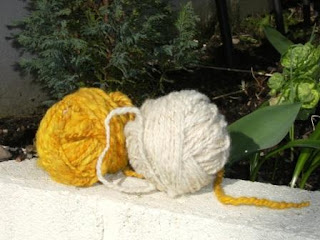
Once your yarn is dried and wound it is ready to be transformed. My grandmother would use some of the undyed wool to make socks and jumpers for the family. The remainder would be send to the local weaver to make blankets (more on weaving in a later article).

Below is a cushin cover I knit using some traditional aran stitches i.e. cables and blackberry. In my next article I will explore the origins of handknitting in Ireland and also have a look at the weaving of the multicoloured sash or belt known as the crios.

As always I welcome any comments on this article and ideas for future explorations. If you are a crafter who would like to be linked to any of the series of articles please let me know.

Till we meet again, take care.

Mo
aka http://www.huggleknits.etsy.com/

Next article due 29 April.........

Thursday, 25 February 2010

Full Circle - Irish Traditional Crafts

Chapter 1 - Spinning


We start our craft journey with the basic textile ingredient that was and has been available on most farms in Ireland from earliest times - sheeps wool and its preparation.

The sheep is shorn using hand shears (today many shearers use electric sheers for speed) and the fleece is taken off the animal in one continuous piece. It is then spread out and sorted. Some people will spin directly from the fresh fleece but that depends on the breed of sheep and the quality of the wool. If preparation is needed the fleece is broken up and washed gently so that it does not felt (fuse together). It is then spread out on a stone wall to dry naturally.

When dry it is teased - gently pulled apart, spread out - and any grass, twigs etc are removed. If very dry ( i.e. no natural lanolin remaining = the sweat of the animal) it is greased at this stage to make it easier to spin. Oil, paraffin and goose fat are just some of the substances that have been used. Once greased it is then carded to take out the tangles and rolled up ready for spinning.
The prepared rolls of wool are used to spin the yarn by either using a hand spindle or a spinning wheel. The same principle is used with both. To start you draw out a small piece of wool from the roll, twisting as you go, tie it to the spindle and continue twisting in the same direction drawing out the yarn and winding it onto the spindle. When the roll is used simply add another to the end of it and continue winding.
In Ireland there were traditionally 3 types of spinning wheel in use - the big wheel which was found mainly in the counties along the west coast of Ireland and was used while standing up, the smaller version of this wheel used in the southern counties and the small flax wheel which was introduced in the northern counties in the 1700s by the Royal Linen Manufacturers in Ulster. Not many of these wheels now remain in use. When I was on the lookout for a wheel last year there were none of those wonderful wheels available so I bought a small Ashford Traveller that I have named Jessie after a very special sheepdog that my grandfather had when I was a little girl.
I learned to spin on Clare Island last year with an amazing lady called Beth Moran (thats her husband Mairtin sheering the sheep). She also taught me how to dye the spun wool using onion skins to get a bright orange colour. The results of my first attempts are below......

Today in Ireland we have some amazing spinners and dyers who make yarn by spinning all types of natural and synthetic fibres. http://www.etsy.com/shop/LHogan and http://www.etsy.com/shop/Lysulka are just two of the CraftyIrelandTeam who are actively spinning and dyeing. You should check out their etsy shops.......
As yet I am a learner and spinning just for my own amusement. I am currently making a waistcoat from my first spun wool - I will show you how it turned out at a later date. For now I am just happy to spend some quiet time with Jessie when I can.
If you are a spinner, either wheel or spindle, and live in or near Dublin, Ireland, you are welcome to join the Dublin Spinners who are meeting next Sunday 28th February in the Powerscourt Balcony in Dublin City Centre. I am sorry I wont be able to make it this month unfortunately so I will miss out as Laura http://aranbrew.blogspot.com/ tells me that tea and cakes are also on the agenda.....
More information on the Dublin Spinners group at the following Ravelry page http://www.ravelry.com/discuss/dublin-knit-collective/859081/101-125.

Thats all for this month. Next topic is Natural Dyeing and Knitting coming end March.
Cheers for now
Mo

Wednesday, 27 January 2010

Full Circle – Irish Traditional Crafts


This is by way of introduction to a series of potted histories of Irish Traditional Crafts and how they relate to some of the work of the amazing crafters in the CraftyIrelandTeam. During the year I will be looking at Wool Spinning, Knitting, Crochet & Lace, Weaving, Felting, Patchwork, Woodwork, Woven rushwork, Bookbinding, Calligraphy, Jewellery and Stained Glass. You will see how the current crafters have brought their own creativity to that of the traditions of the past to ensure that these crafts will continue to grow and develop and not be lost. Each article will be published here on the last Thursday of the month and the final one will gather together all the newer crafts that have found a home here in Ireland as they too will become part of the traditional Irish crafts for the future.

Since time began basic human needs dictated that we had to clothe and feed ourselves and provide shelter. All the skills were passed down from mother to daughter and father to son. Each century brought new and exciting discoveries and inventions and humankind had to learn new skills to live in the world that was opening up before them. Every country has a wealth of exciting craft workers and artists and Ireland is no exception. While fashions change with each generation, basic skills remain the same. With the continued expansion of the world markets it has become cheaper to buy clothes, furniture, rugs etc than to make them. However, I believe that quality will always suffer so I am glad to see in recent years there has been a return to the joy and value of hand made and hand crafted.


My grandparents lived in the west of Ireland on a small holding in Co. Mayo. My grandmother would spin the wool from their own sheep, knit jumpers and socks for the men and send the rest to the local weaver to make blankets. While I have been a knitter / crocheter for many years it is only in the last few years that I learned how to use the hand spindle and last year I became the proud owner of a spinning wheel - affectionately called Jessie ( more of that later, tis a long story)

So this is where our journey starts. Over the year I hope to add to my skill set by learning as many of these crafts that are part of my family's history as I can. I will keep you posted on how I get on. As well as giving you a look at each craft I hope to be able to introduce some of the CraftyIrelandTeam crafters to you all. The next installment will concentrate on Spinning yarn/fibre/wool etc. So can those of you who are spinners or fibre sellers who would like to be be included please convo me through my etsy page http://www.huggleknits.etsy.com/ . If you are involved with a traditional craft that is not listed please get in touch also. Finally, all comments on this article and any part of the series are always welcome.
Cheers for now
Mo
aka - Murraymint

Next article date: 25 February - Spinning........