Though far from a literary scholar, I've always loved this celebration of James Joyce's, Ulysses. The book was set in various locations all over Dublin on 16 June 1904. Festivities, fun, Edwardian-themed events and pub readings take place all over the city (though the festival is by no means limited to Dublin or even Ireland for that matter.) You don't have to be involved in the entertainment to dress in costume and for me, this has always been part of the attraction. Think Mary Poppins and My Fair Lady and you've got the look, though in reality, anything goes as long as you vaguely reference the book.


A bow tie or cravate is good, the dandier the better. Add to that a pair of round wire rim glasses or monacle from a charity or vintage shop and away you go.
 For the girls a high neck blouse is the staple for your Edwardian look. This vintage 198os shirt from Little Blue Cottage will do perfectly, though you could get your needle out and sew on a bit of lace.

Brooch Necklace by Amazing Beads
 Peridot Crystal earrings by ViviBijoux

A working class girl would have worn simpler lines. The closest I could find is this vintage 70s skirt from Dandelion Daydreamer. It would do nicely with a long petticoat underneath.
Pull your hair up into a loose bun. Oh and don't forget to stick a feather and/or some flowers in your hat ladies!
 A crochet shawl or lacy wrap will complete your look. I made this one a few years back, by tea-staining my mum's old kitchen curtains.
To tea stain lace, make up a basin of strongish tea. Remove the teabags before adding in wet lace. Stir with a wooden spoon. Leave until the desired colour is achieved, though bear in mind the fabric will look darker when wet. (I would experiment first before attempting to stain a good piece of lace.) Rinse and then wash gently with a little washing up liquid to remove any acidic residue. Rinse again with water and hang to dry.
I stuck a few strategic stitches under the arms and sewed on a hook and eye with chain clasp that I bought for next to nothing. On my feet I wore an old pair of lace up 1980s boots I found in the attic, but a low shoe will do fine.
 Peridot Crystal earrings by ViviBijoux
Skirts were worn long but not as wide as in the previous century. Well-to-do ladies would have worn a special corset to create an 'S' shaped figure (most uncomfortable I imagine.) A small bustle could simulate a similar shape - so why not let your creativity loose and make one!
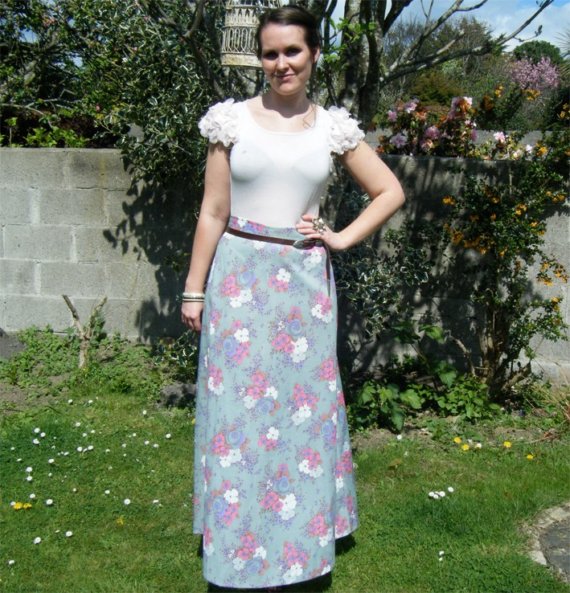
A working class girl would have worn simpler lines. The closest I could find is this vintage 70s skirt from Dandelion Daydreamer. It would do nicely with a long petticoat underneath.

Pull your hair up into a loose bun. Oh and don't forget to stick a feather and/or some flowers in your hat ladies!
 A crochet shawl or lacy wrap will complete your look. I made this one a few years back, by tea-staining my mum's old kitchen curtains.
To tea stain lace, make up a basin of strongish tea. Remove the teabags before adding in wet lace. Stir with a wooden spoon. Leave until the desired colour is achieved, though bear in mind the fabric will look darker when wet. (I would experiment first before attempting to stain a good piece of lace.) Rinse and then wash gently with a little washing up liquid to remove any acidic residue. Rinse again with water and hang to dry.
I stuck a few strategic stitches under the arms and sewed on a hook and eye with chain clasp that I bought for next to nothing. On my feet I wore an old pair of lace up 1980s boots I found in the attic, but a low shoe will do fine.

Now you're all set to go. If you are not close to any official festivities, find a good Irish pub and start your own Bloomsday party. Enjoy!